Christopher Carter

Christopher Carter is a California based artist working in found-object art. Here he discusses his recent 2008 exhibition Bound. In this section view images from his show, and explore his commentary on his work.


Biography

Christopher Carter

Born in New Mexico and raised in Boston, as a 15-year-old student at the renowned Interlochen Arts Academy, Carter began to imagine a career as an artist. He went on to pursue a BFA from MICA (Maryland Institute College of Art) with a specialization in printmaking, multimedia animation, and bronze casting and foundry in Cortona, Italy. His interest in sculpture intensified during graduate school at the University of California at Berkeley, where he received his MFA in 1995. 

In 2002, Carter spent a summer in New Zealand studying the art of the Maori people. His own multiethnic background had earlier drawn him to African-American and Native American wood carving traditions. A series of monumental carved columns incised with abstract animistic imagery in low relief were the result of this exploration. The work titled “Totemic Columns” was recently purchased for the reopening of the 60Mil+ Grand Rapids Arts Museum in Michigan for permanent display in their ground floor atrium. The GRAM is the first LEED certified Museum in the world and Carter’s extensive use of salvaged materials, including reclaimed woods and found objects made a perfect relationship.  (Content provided by Christopher Carter 2008)
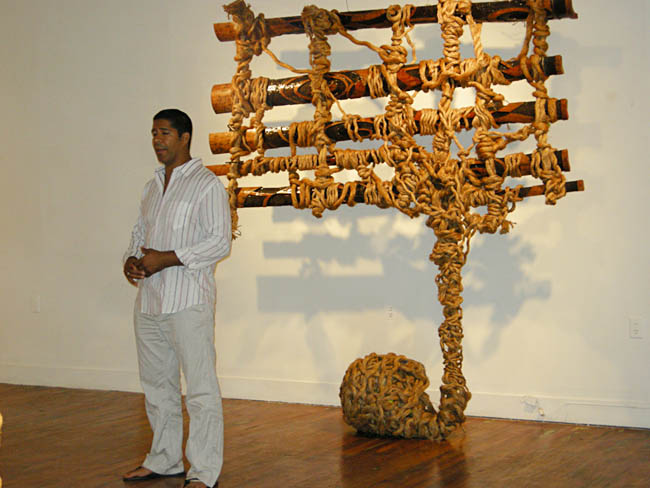
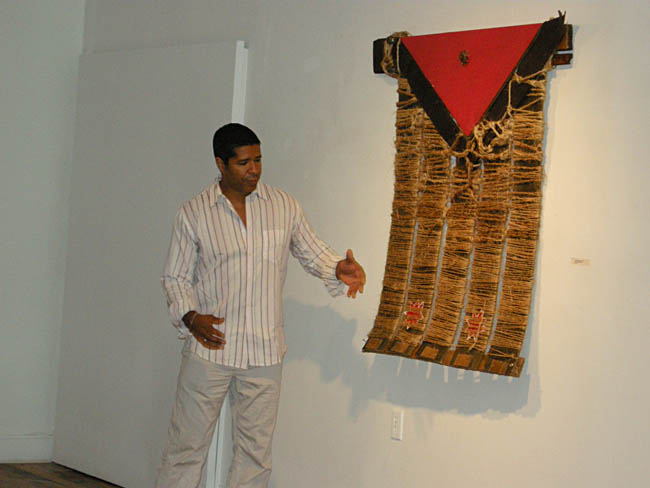
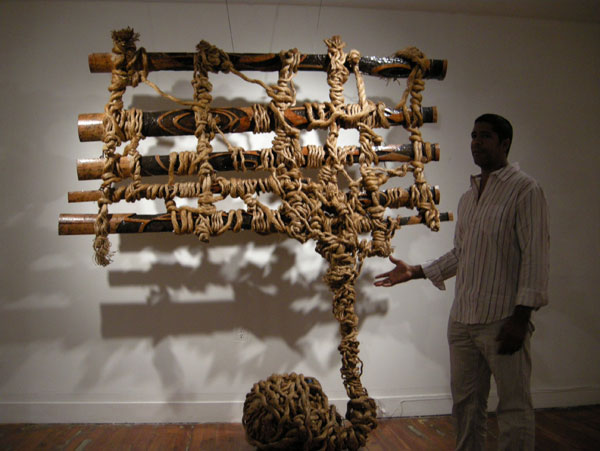
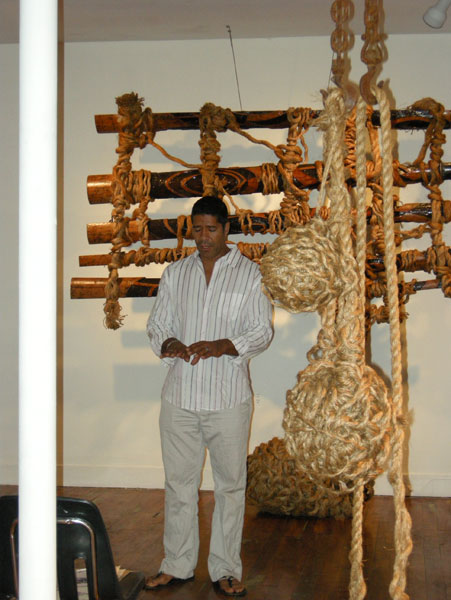
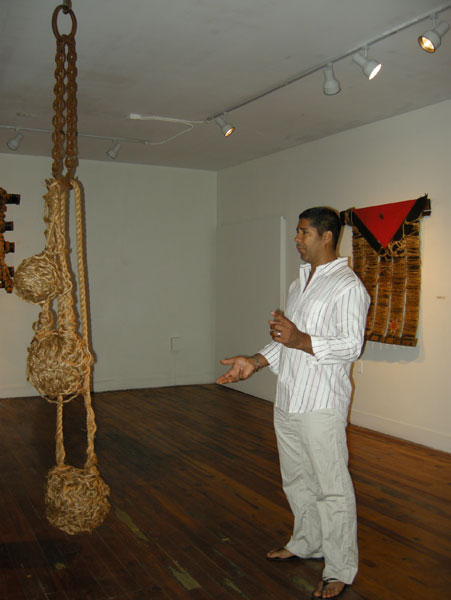
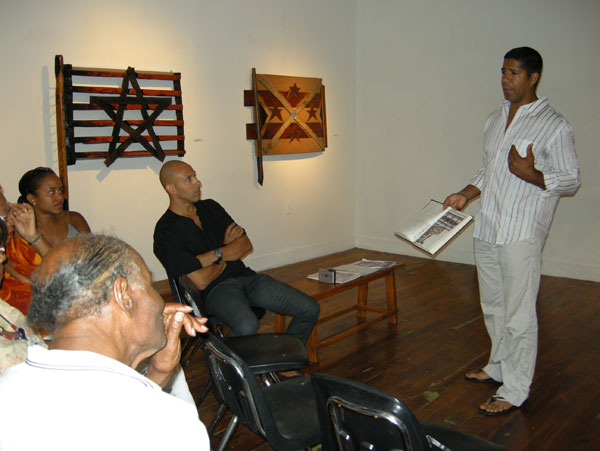
Christopher Carter discusses his works at the Diaspora Vibe Gallery


CV

Christopher Carter

Solo/Group Shows

Museum Acquisition 

Grants/Awards

Education

Teaching

Professional Experience

Representation (West Coast)


Gallery 1

Christopher Carter

"In art, there are recurring images, obsessive symbols or conceptualized representations that are used as vehicles for a certain interpretation of the world. Such recurrences establish codes that allow the activation of symbolic levers of imagination or bring one’s experience and knowledge up-to-date through unusual - or common - associations. 
In a wide range of today’s art, this symbolic existentialist tendency inherited from expressionism and surrealism exists, which refers us, in addition to its poetics and its ways of representation, to the important questions of modernity: who are we in this post world war era, what is our ontological status in this contradictory reality. The work of Christopher Carter is placed in this labyrinth of the unknown, which opens when man enters in contact with objects, culture and the every idea of art.

One only has to look at Christopher’s art to see the intellectual origin of his ideas, and one can, if memory prevails, see images and hear messages from the pieces dating back to the1940s. Then art became a sharp instrument of social criticism, politics and critique of daily life. Each exhibition became a cultural discourse based on the political climate of the times. Christopher has indeed questioned the socio- cultural content of these years and in spite of his rough trajectory from the artistic utopia of those times has kept his vision of art as experimentation and investigation.

Enjoy this body of work presented in Bound 2008: The man, his work and his art as we continue the dialog the work encourages about war, peace, boundaries and what the nationhood means when seen through the lens of our/your flag." (Content submitted by Rosie Gordon-Wallace May 2003) 

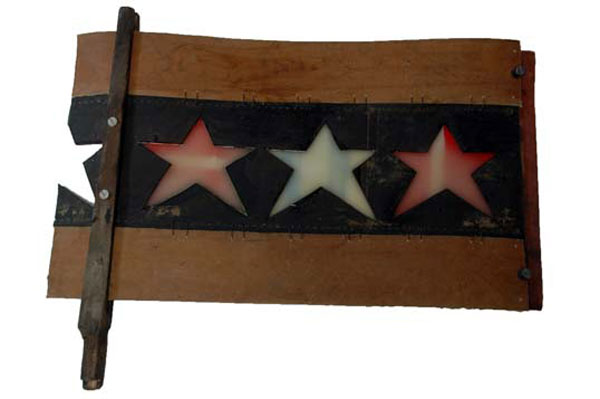
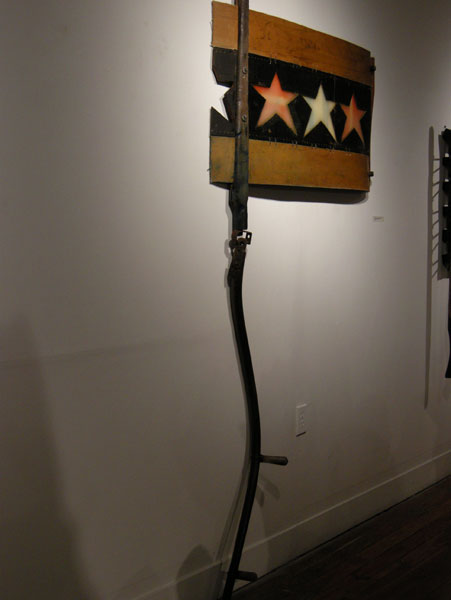
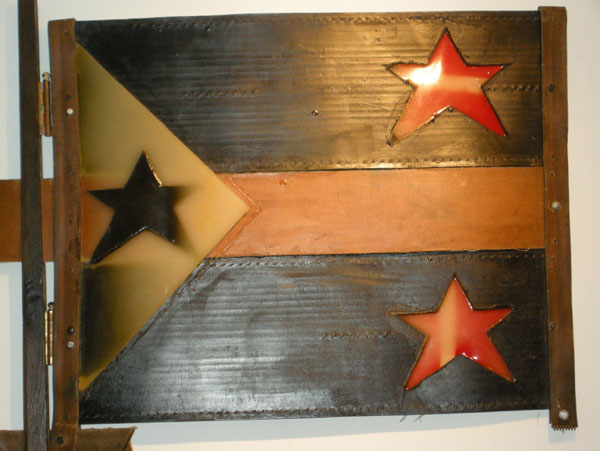
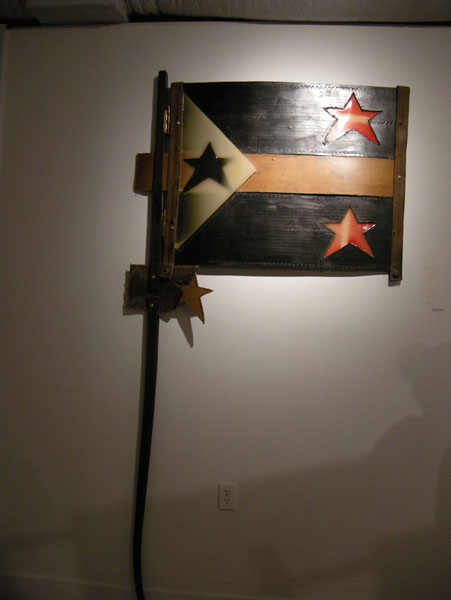
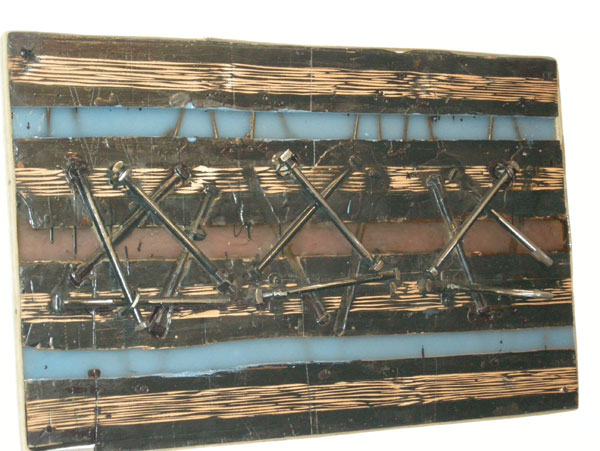
Belted Three and A Half Star

Belted Three and A Half Star


Gallery 2

Pulled From the Fire Belted and Bound

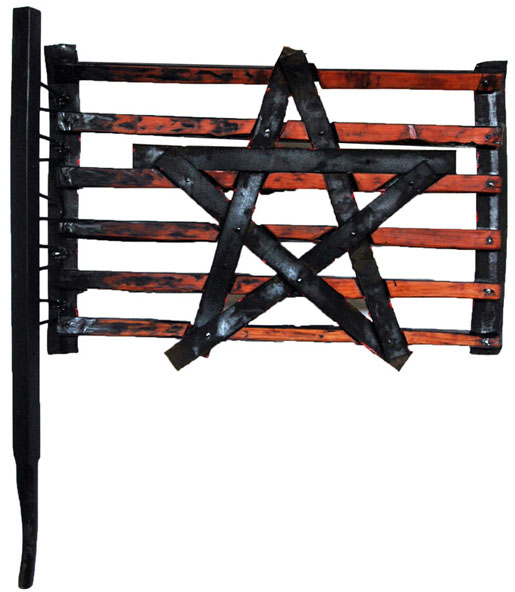
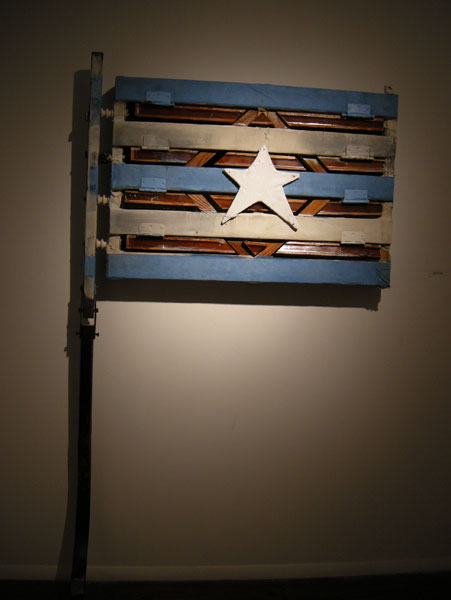
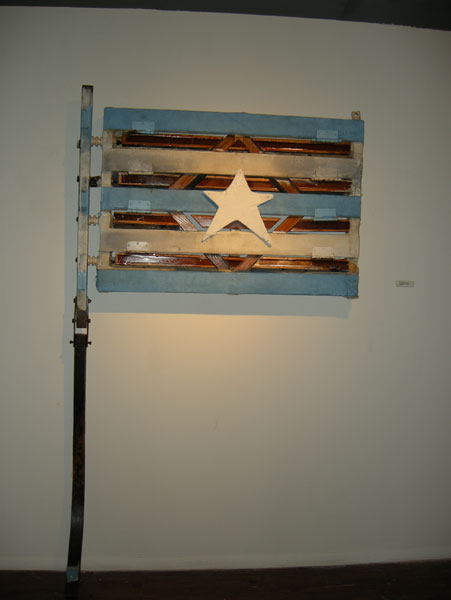
Belted Three Star Belted Three Star


Gallery 3

 Bound 1  Carter discussing Bound 1

Bound 2  Bound 2 at Diaspora Vibe

 Moments  Moments and Bound 1

Carter discussing Moments


Gallery 4

Broken Broken

Spear

Spear

 
 Plank Poem 1 and Plank Poem 2  


Gallery 5

Christopher Carter gives an artist talk at Diaspora Vibe Gallery

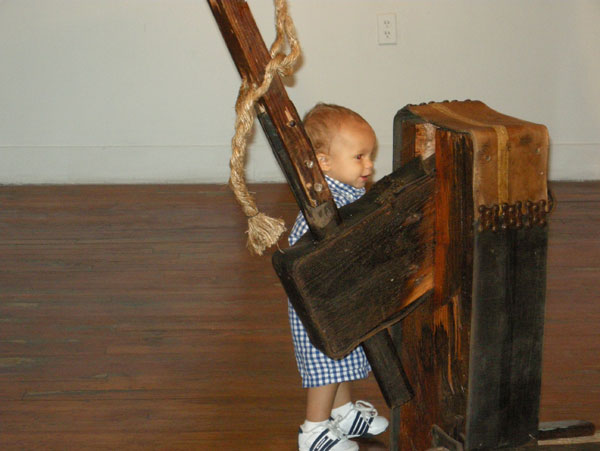
A young art critic comments on Moments

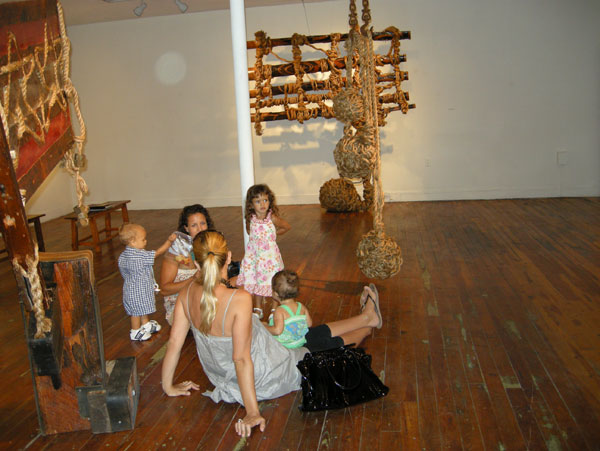
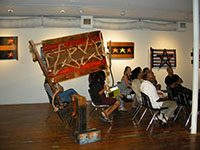
Viewers take in the Bound exhibition Six Star

Gallery 6

Three Star Travelling Star

Travelling Star Two Star

Gallery 7

Close up of Two Star Attendees at Chris' Artist Talk


 Back View of Two Star Base of Two Star

 
Wrecking Ball  

Interview 1

Patricia Saunders Interviews Christopher Carter

General Comments:

Patricia Saunders (PS): I’m looking at the exhibits and wondering if a part of your art training, did they teach you how to hang work? Or how do you decide based on weight and space? How do you know where to hang?

Christopher Carter (CC): That’s a great question. They don’t teach you how to hang.

PS: So installation art is purely…is it gut?

CC: Yup. Installation art is purely a gut feeling. It’s just a necessity. If you’re going to make it you’ve got to figure it out. I would say, in art education, and you know I’ve taught myself at Berkeley, they don’t teach you the business of art. Which they really should. They may be doing it now more, but in my undergraduate experience it’s something you have to learn on the spot.

PS: I’m looking at the exhibit and the weight of some of them and wondering how you decided what would let this hold up or is it trial and error or that sort of thing.

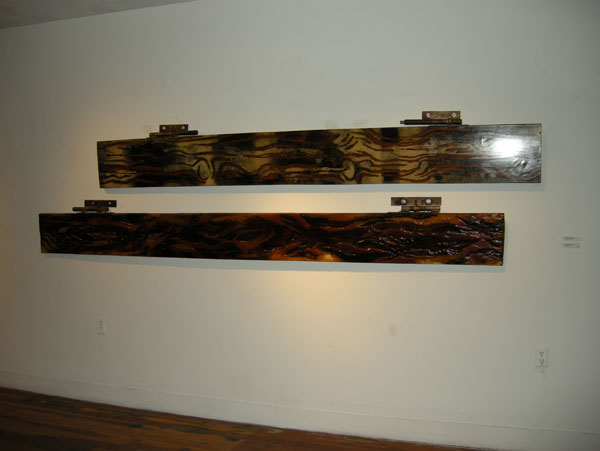
CC: Well I’ve learnt from previous experience if you notice the hinges here they can slide from one side to the other so that helps me to find a stud so if I have studs in the wall. And this goes back to, you know, I’ve built many things. I’ve laid floors, I’ve worked with contractors and then when I have commissioned pieces like this and such I’ve called up a contractor and said “Hey, man, can you have a look at this house? Can you come and help me decide where is the best place to put something like this?” By doing that it allows me some leeway.

PS: So you’ve got to have a little engineering built in. A little design.

CC: […] I think that’s what moved me away from painting, in a way, because painting is difficult. I’ve been painting as a job. I was a background painter for Colossal Pictures. I painted backgrounds for animation. I painted murals. I painted cafes. I painted awnings…In a way it drove me […] I was like, I’m going to paint all day for my job then come home and paint for my Master’s?

PS: Have you always worked in found object art?

CC: I have been working since ’93

PS: To what extent does your identity as African American, as native American influence your art work? Is it a successful point of conscious political position or are you into the object and then does that identity embody the object?

CC: I don’t think I approach it thinking in those terms but I comes out in the work. So when I’m spending time with the work, when the ideas start to become realized, when I’m nearing getting to that statement, then it could sway me one way or the other, for me. I had to struggle with that a little bit with my mother being white and my father being black and then the American Indian. It was a difficult time trying to navigate that. And I would say that I did resist the idea that I was a black artist. I just think of myself as an artist. I’m an artist first. I’m not trying to deny that I’m of mixed race or anything like that. I definitely felt that I was being labeled. And as a mixed race person you’re already being labeled. And I feel like “God, I’m being labeled again?” And sometimes that’s kind of a risk. Because people feel like ‘What is he saying?” I’m just – I’m an artist. And then I’ve actually been told, some people will say “You’re not an artist. You’re a professional artist.”

PS: Everyone’s got a box. Is this the first time you’re showing this exhibit?

This is the first time. These have been in LA, and I did a number of these that were sold out in San Francisco because they never had a show. They just went in to this gallery that just sold them which actually created an interesting [situation] for me. I wasn’t having any shows but I was selling work. And a couple of my other artist friends were like “What are you complaining about, you’re selling work” and I’m like “But I haven’t had any shows. I’m not showing. These things are getting scooped up. I don’t even know where some of these things have gone.”

PS: I was gonna ask you, where have some of these pieces [gone]?

CC: I know that some of these pieces were put in show homes in Vegas. And they were sold with the houses in Vegas. So the designer of the homes, he bought these pieces and then sold them with the house. Then I think I had five more that went to another designer, architect from San Francisco who is doing work in Hawaii [..]

PS: When I saw the card I thought okay this is an exhibit that is going to talk about citizenship. Of course, critics look at the flag and they think citizenship, national identity and the contestation of all these things and what are we bound too in terms of calling ourselves American. For me that’s what the flag meant. What did it mean to you?

CC: For me, actually I was looking over so many different flags of so many different countries and nationalities. For me I always like to find those similarities so for me the thing that was bound of all the flags were the similarities, the graphic nature of each one.

Belted and Pulled

PS: Whether we want to admit it or not we talk about the Americanization or Islamic identity all of these different things are tied to flags and what they represent…this exhibit it wrests that sacred item out of that sacred space and by using found items it says that it says that there’s a degree to which each one of us inhabits the flag differently just in the range of materials…

CC: Yes, I really strive for that. As you saw through some of the sketches, I really was pushing myself with all the materials. The materials to me are like all the different colors that you might be able to make on a palette. So that was one of the things. As I was combing through my rolodex of materials I’m finding materials that I know this is right. You know. I know that these types of nails are the nails that I should use to put this piece together. Here you can see how constructed, I hinge a lot. I knew that this was what I wanted to have happen in this piece. You can see how I customized all these things to work properly. And then I knew, not screws.

PS: Why not screws? How do you make that decision?

CC: For me, well what you might call the flavor of the flag, the intention and the concept behind this piece. This was meant to be an early piece. Pulled from the Fire is for me, I felt that screws would bring it to a contemporary place.

PS: Most people never know how artists arrive at this. This is interesting. The nuts and bolts. Why the staples here? Is this pragmatic?

CC: The staples, this kind of stapling method allowed this to breathe. Like a flag.

PS: And what’s this made of?

CC: And this is one of the belts. This is an actual belt.

PS: It really is from a conveyor?

CC: Yes. These are real belts. This is leather. It’s a leather belt from the 1920’s. These were all in the rafters.

PS: So you literally just took the whole thing apart.

CC: Yea. It’s crazy. Yea and then over above there were these large metal spools that these things wrapped around.

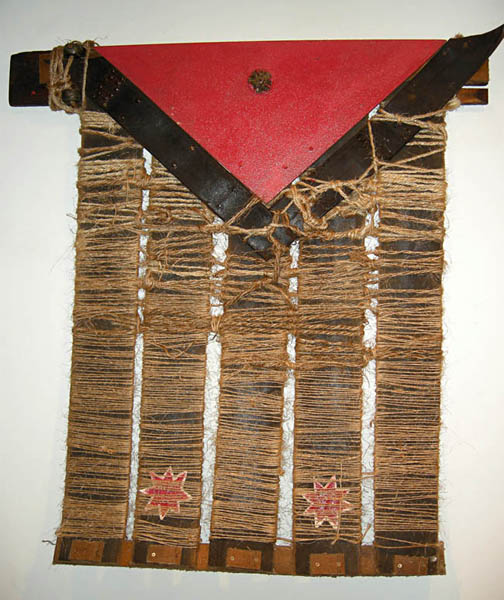
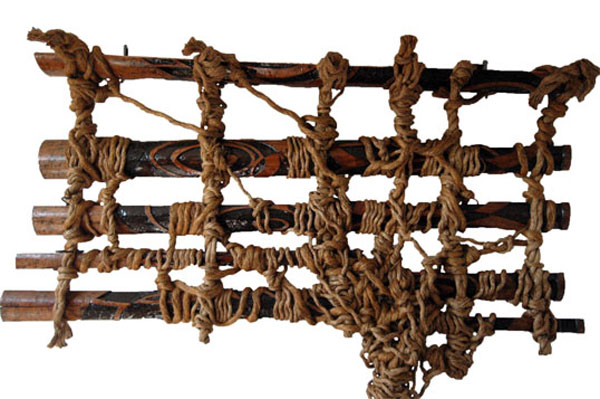
Bound No. 2

PS: And now we come to the Bound piece.

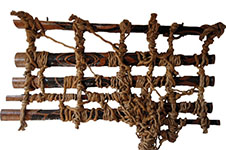
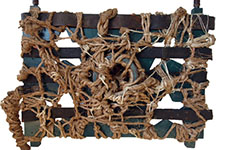
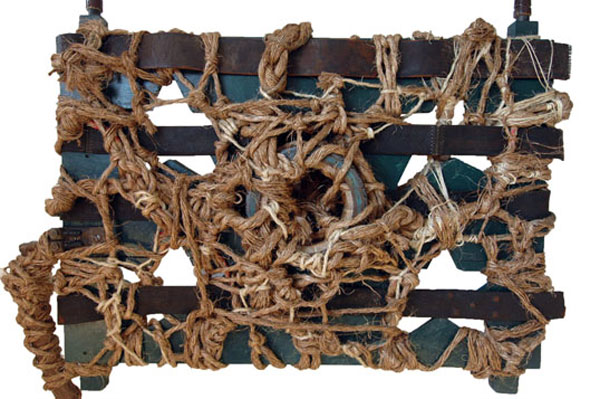
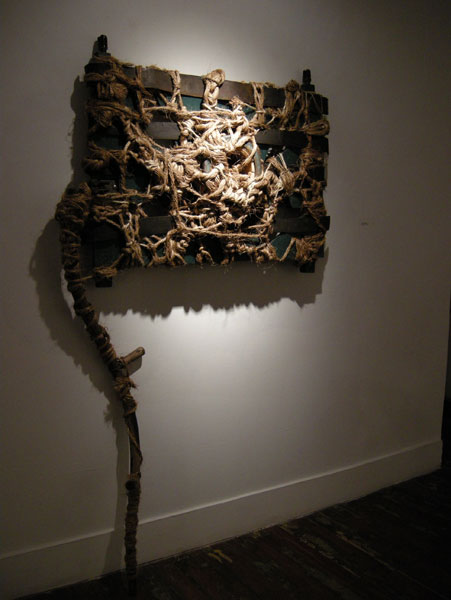
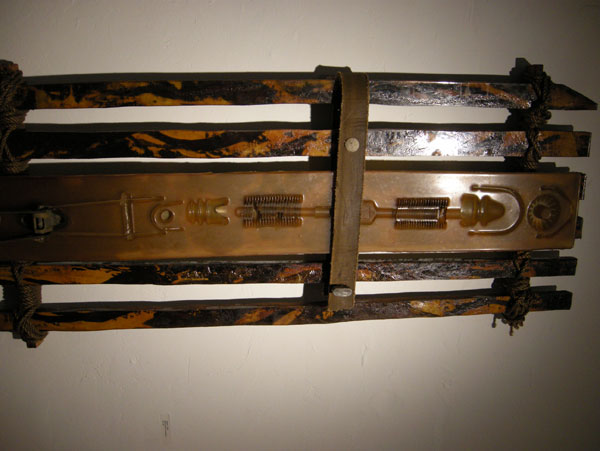
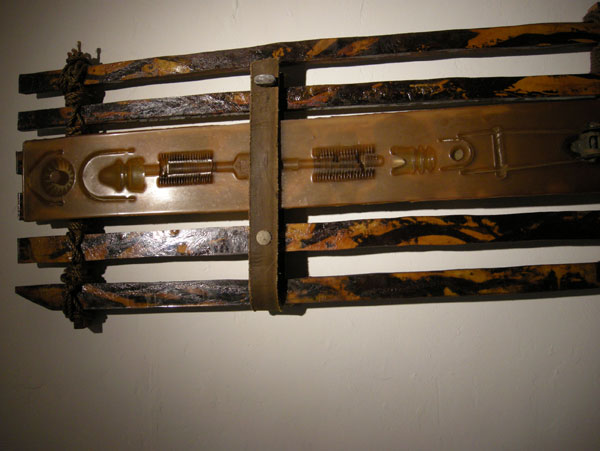
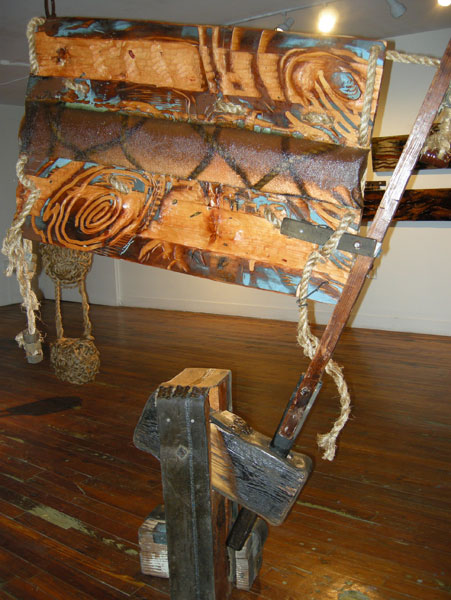
CC: This one. Manic. Manic, I tell you. I was really into this one. I got kind of crazy. What I did on this was I wanted to obscure a flag because you can see the stars. But more often than not most people don’t see the stars at all until I point them out until I say something about that and that’s fine. I realize that I should like that about this. This piece is a whole deal. Takes a lot out of you. You gotta look at it. So here we have these belts that became the stripes you know on the flag so it’s…stars and stripes. This is a found piece of metal. This is from a column, on the inside here…At first I wanted this to be a bit more open then I thought no I like this much more congested.[…]This particular hinge here it was probably for laying an electric cable. And this is a piece I’ve probably carried with me for about 5 years.[…] the Scythe also gives the feel of a working man’s flag…and it has the feel of a clean line that you might make with a paint brush. They are also from the barn. 

PS: Now this piece I notice has kind of a different, it’s not just rope on this one.

CC: Yes. These are so old and I just couldn’t help myself. I wanted to add that. To keep going with that.

PS: Is this all rope holding this together?

CC: Yes. It’s all rope.

PS: What’s with the rope? How did you choose that as opposed to any other kind of—

CC: Well for a raft, I haven’t seen any rafts bound with anything else. That would be the short answer. The long answer would be that I found an affinity for rope when I was in Art Basel in 2004 when I did a size specific installation piece. I used rope then. And beyond using rope for imagery for my woodcuts, rope became for me something I could use in my sculpture. I’d say I graduated. Because I was making still-lifes. Tying knots and then sketching them out and then carving them out of the woodcuts. So when I was making these still-lifes I started to get an affinity for making these knots. And then I was going knot crazy. Now I confess I don’t know the names of all of these knots that I’ve been creating. But I did have a couple of sailors and boaters going “Oh yeah, that’s a double hitch.” And they were pulling out the names. And I said “That’s really cool” I didn’t even know that was the name for the knot that I was creating but they said that the knot that I was creating was actually useful. But that’s the – it started in one body of work and was actually the subject of a body of work and then became the material.

Three and Three Half Process

PS: Now this piece is interesting it looks like the star fell off. Is that what happened?

CC: Again this is a play off the process. I wanted to show some of what’s going into just sort of cutting and creating some of these pieces. And here is where I started really playing with the opacity of the rubber. Getting a sense of how thick it would be when it was completely opaque and how thin it would be when it would allow light to pass through it.

PS: So all of this is rubber. Where do you get rubber?

CC: There are suppliers. I live in Oakland California and a lot of people use latex rubber for theatrical productions, living masks, things like that, and it’s used in construction. Different types of things like that. I found a couple of great distributors which actually I’ve been able to experiment with. There’s many different types of rubbers that have different opacities, different viscosities different abilities to take on tints and colors.

PS: So you mix your own colors?

CC: I’m learning every single time. Some things happen you don’t expect. And you can lose a piece. But you come back the next time and you remember what you did wrong the time before. After a while it’s just like mixing paint. You kind of know what to mix. It’s the same thing with the rubbers. There’s some rubbers that won’t take pigment.

PS: Is this the natural color?

CC: No I added that.

PS: The pieces I’ve seen didn’t include the scythes. It’s interesting when you think about the national anthem and there’s fields of green, there’s a kind of functionality to the equipment.

CC: For me I thought this really worked for what I was trying to say well because it’s almost the working man’s flag. And also in this sense the way that this piece is unfinished it’s a Three and a half star. The idea that this is just running off the belt and you’re just catching it.

PS: It’s an interesting pause that let’s you know there was something there.

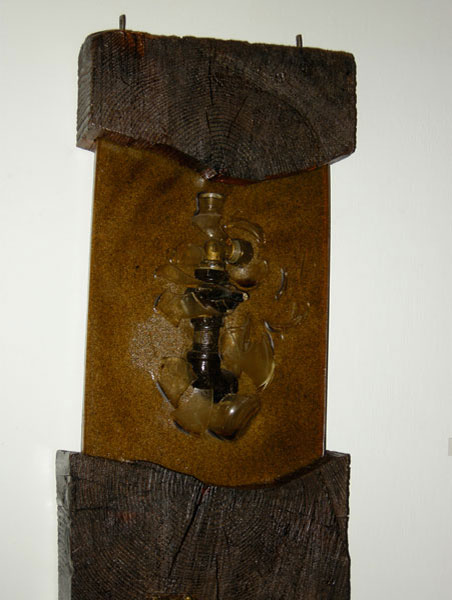
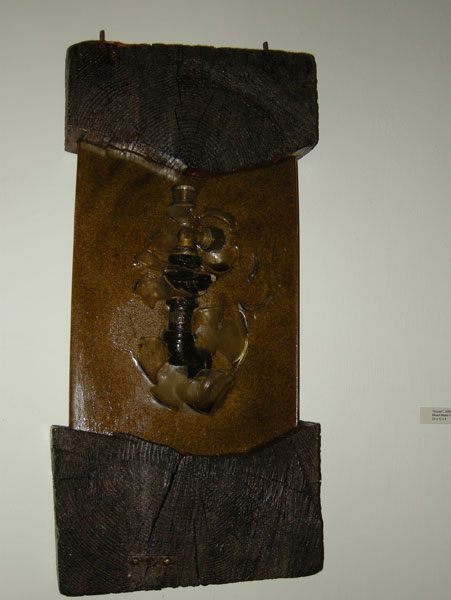
Spear and Broken

PS: This piece to me is really fascinating. How did you – it’s not wood, or is it wood?

CC: I’ve got you second guessing. It’s wood and it’s resin.

PS: So is there wood in the resin? What am I seeing?

CC: That’s a carved area that I’ve filled in with resin. And then I came back and carved it out again. It’s like one step two step three step, almost four before you get to this sort of point. And I can say this is one of those pieces that I cannibalized. This piece was at first meant to be like a raft until I added this. So when I created this, it really said to me, it actually reminded me of some of the confederate flag symbols where they have a circle […] and there was a piece of metal that I then took out. It’s a negative. That was something I discovered optically I wanted to play with that. From the raft, this particular imagery of the circular piece I thought of getting across the Mississippi river.

Plank Poems

PS: Are these actual pieces that also came from the barn?

CC: Yes these are also actual pieces that came from the barn. And then also the interesting thing about this piece is that we weren’t able to hang it the way that I was hoping to hang it. This piece would be coming off the wall.

PS: So that you could see behind it.

CC: […] this actually does allow some light to come through it. This was a difficult piece to pull off.

PS: Is this gel? How do you get these pieces [here]?

CC: The process is […] a solid piece of wood. This is actually one plank and then another plank. What I do is basically build around with wood which I then take off later. I build a frame around this whole piece then I cut…and separate them out. Then I do the same thing as I did over there where I customize. So I carve up each side so these all are giving this rigidity.

PS: So this is rubber?

CC: Yes.

PS: This is a very interactive piece. You never get to touch art.

CC: […]What I also learned…is that if I use an enamel based paint it doesn’t absorb into the wood.

PS: There’s a lot of pragmatics. What I like about your work is that you use, instead of going and getting special paints, house paints. It’s really using the everyday and using what the everyday gives you.

CC: Yes I almost never go to the art store anymore. Yes in my youth I did. I would go to the art store all the time. Now I try to go to a local hardware store.

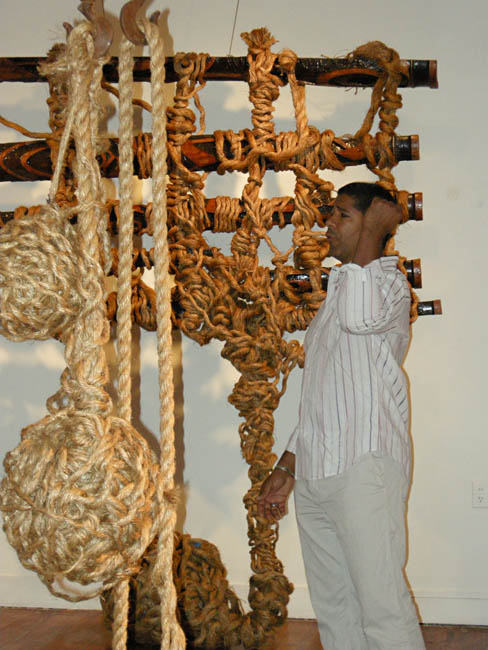
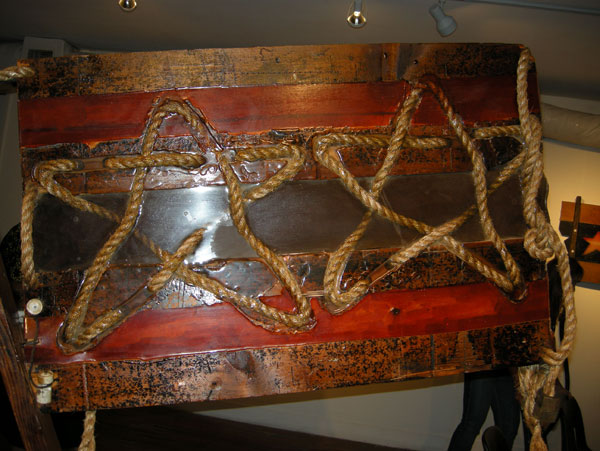
The Wrecking Ball

PS: And last but in no way least, The Wrecking Ball, because I think that takes us back to the beginning in terms of the barn.

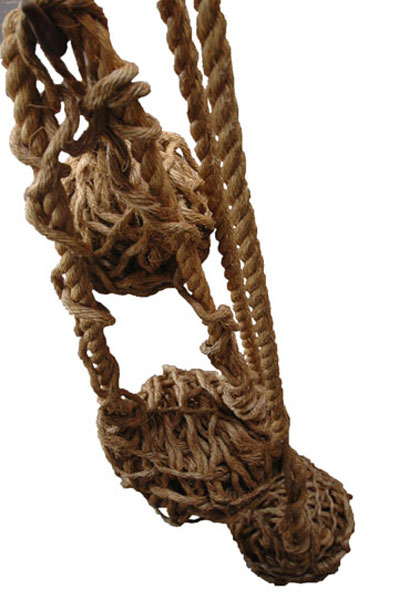
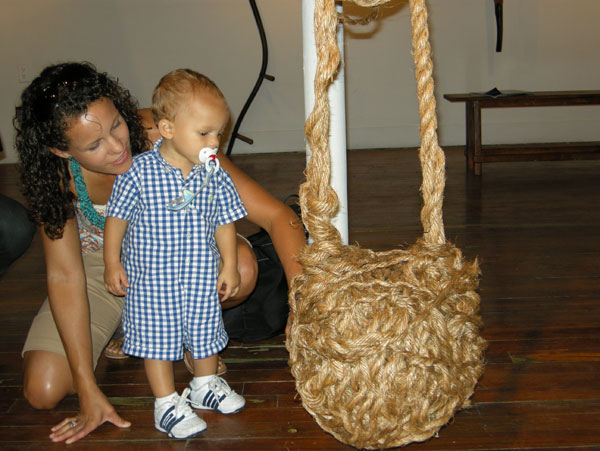
CC: It sure does. The idea behind this piece is the rope the wrecking ball that really ends up demolishing the barn or any other spaces that I get materials from. And of course I wanted to get creative in the ways that I put this in at first. And I tried a couple of different ways. It worked here. In this space it worked well. I will confess that in this particular piece it is hollow. It is wrapped around a plastic vessel that I kind of created.

PS: Where do you get this stuff from?

CC: When you live in the Bay area, Oakland, San Francisco, there’s lots of shipping and so I’m able to get spools and stuff and usually what I’d get is spools some of them had been corrupted because they’re scared to use it because it could snap. So I can regularly get recycled materials. So I’ll show up and there’ll be a whole spool and if part of the spool is crudded up or deteriorated in some kind of way. Lots of times they’ll just give me the spool. They’ll say just give me fifty bucks and you can have the spool. It’s very affordable.

PS: Were you always interested in the found object art or was that a necessity?

CC: When I was a painter, I was asked to paint a client’s kitchen and they wanted me to do like a floral motif on this column. Then it turned out that they had a couple extra because they were working on this house. A couple of them were cracked and the contractor said to me, “You know I saw you painting that column. Do you want a couple of these because we’re not going to use them.” So I took two of ‘em back to my studio and that’s how I started using those materials. After I carved my first two, the response that I got was really a great response. They really thought it was original and new. So then I started getting out there looking for columns. But then from columns I went to telephone poles. So telephone poles was another thing I could get out there. When I was getting my Master’s I carved up a number of telephone poles. But they’re treated with toxic chemicals so you shouldn’t use that as material. So that’s also improperly recycled too.

PS: Some of this stuff is so old. Do you have to test it?

CC: I wear masks, I try to do it in a well ventilated area and I just hope for the best.


Gallery Index